SPC AC 140100

   Day 1 Convective Outlook
   NWS Storm Prediction Center Norman OK
   0800 PM CDT Tue Oct 13 2026

   Valid 140100Z - 141200Z

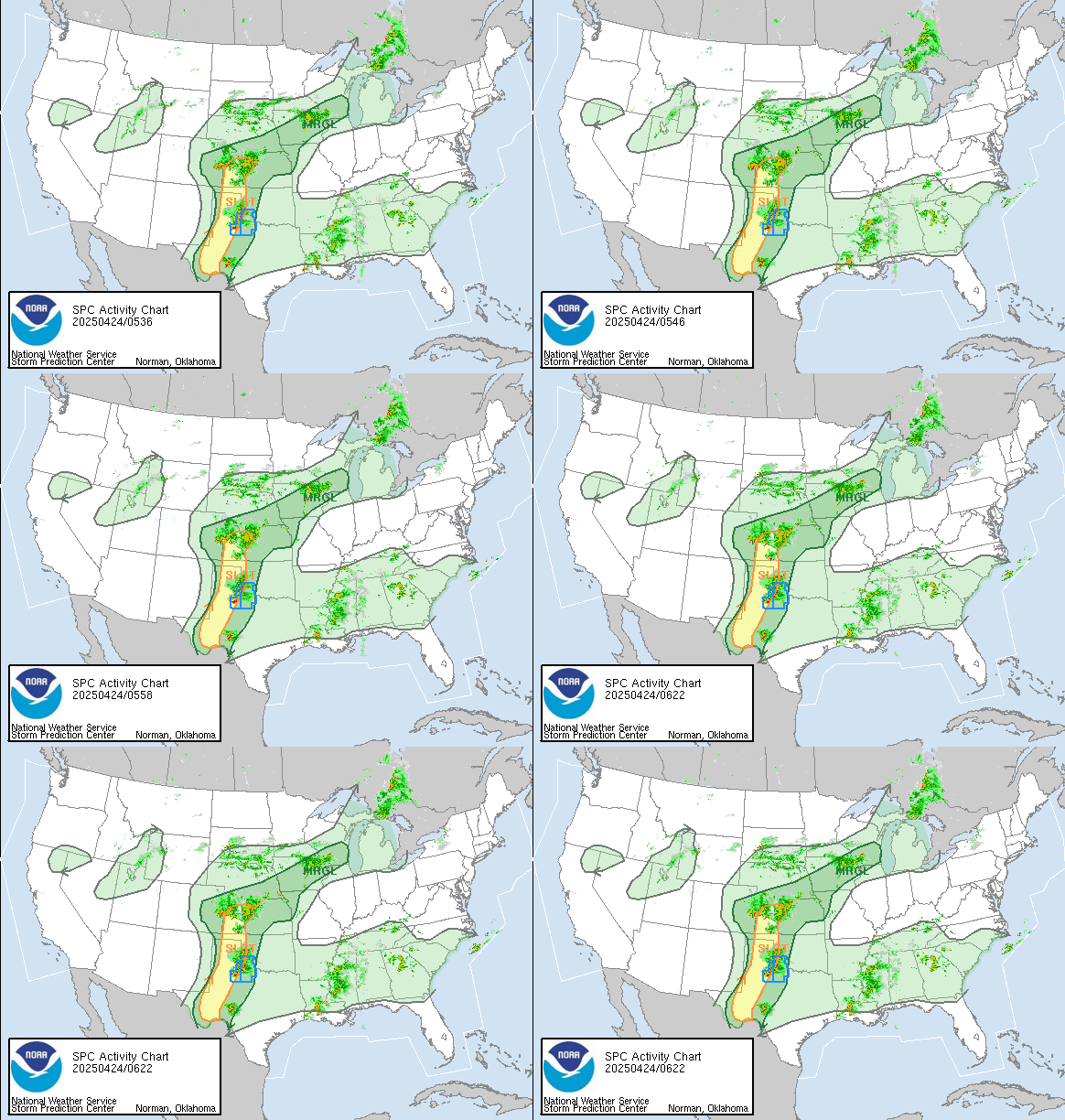
   ...THERE IS A SLIGHT RISK OF SEVERE THUNDERSTORMS ACROSS PARTS OF
   THE SOUTHERN AND CENTRAL PLAINS INTO THE LOWER MISSOURI VALLEY...

   ...SUMMARY...
   Scattered severe storms capable of large hail and severe gusts are
   expected this evening into tonight over parts of the central and
   southern Plains into the Lower Missouri Valley. Isolated large hail
   may also occur in the southern Great Lakes.

   ...Southern and Central Plains...
   The latest water vapor imagery shows an anticyclonic flow pattern in
   place over the eastern two-thirds of the nation, with southwesterly
   mid-level flow from the Desert Southwest into the southern and
   central Plains. At the surface, a cold front is located from near
   the Oklahoma Panhandle northeastward into north-central Missouri. A
   1007 mb low is analyzed over the northeastern Texas Panhandle.
   Low-convergence is maximized along the front over the central
   Plains, where scattered thunderstorms are ongoing. The convergence
   axis extends southward into the Low Rolling Plains of northwest
   Texas, where a cluster of storms is also ongoing. Ahead of the
   convergence axis, surface dewpoints are in upper 60s and lower 70s F
   over much of the southern and central Plains, which is contributing
   to moderate instability, with the RAP estimating MLCAPE mostly in
   the 2000 to 2500 J/kg range.

   In addition to the instability,the WSR-88D VWP at Wichita, KS has
   0-6 km shear near 35 knots with 40 to 45 knots of southwesterly flow
   in the mid-levels. Some directional shear is present in the boundary
   layer. This environment will support a threat for supercells with
   cells that remain discrete. Supercells will be capable of large
   hail, severe wind gusts and perhaps a tornado or two. Severe wind
   gusts are expected to become the primary severe threat as the
   primary mode becomes linear, later this evening.

   Further south into western Oklahoma and northwest Texas, the latest
   WSR-88D VWP at Frederick has about 35 knots of 0-6 km shear. The RAP
   also has steep mid-level lapse rates in the 7 to 7.5 C/km range.
   This should support supercells with a potential for large hail and
   severe wind gusts.

   ...Southern Great Lakes...
   A minor shortwave trough appears to be moving into the western Great
   Lakes early this evening. Ahead of this feature, thunderstorms have
   developed over far southern Wisconsin. The storms will track
   east-southeastward into the southern Great Lakes this evening into
   the overnight. The RAP currently shows an axis of instability
   analyzed from western Illinois northeastward into the southwestern
   Great Lakes. Along and near this axis, RAP forecast soundings late
   this evening have MUCAPE around 1500 J/kg with effective shear near
   40 knots. This may be enough for an isolated large hail threat, with
   the stronger elevated storms.

   ..Broyles.. 10/14/2026


   NOTE: THE NEXT DAY 1 OUTLOOK IS SCHEDULED BY 0600Z
   SPC AC 131730

   Day 2 Convective Outlook
   NWS Storm Prediction Center Norman OK
   1230 PM CDT Tue Oct 13 2026

   Valid 141200Z - 151200Z

   ...THERE IS A SLIGHT RISK OF SEVERE THUNDERSTORMS FROM WESTERN NORTH
   TEXAS...ACROSS OKLAHOMA...TO THE WESTERN OZARK PLATEAU...

   ...SUMMARY...
   Severe thunderstorms capable of mainly damaging wind gusts, isolated
   hail and a tornado or two are possible across portions of the
   southern Plains into the Ozark Plateau, and in the parts of the
   upper Ohio Valley and Mid-Atlantic Wednesday afternoon and evening.

   ...Southern Plains to the Ozarks...
   An upper low, initially over the Four Corners, is forecast move
   eastward over the High Plains while southwesterly flow aloft
   increases. A series of convectively enhanced vorticity maxima will
   move along a cold front through the Mid-Atlantic, OH and mid-MS
   Valleys, and into portions of the southern Plains. Western portions
   of the front, modified by convection, may eventually stall and
   perhaps retreat north Wed night in response to falling pressures
   with a deepening lee low over eastern CO and the central Plains.

   Scattered to numerous thunderstorms, in one or more clusters, are
   likely to be ongoing from the mid MS valley into southern/eastern KS
   and central OK at 12z Wed. The cold front will likely be reinforced
   by the convection with the morning outflow potentially causing it to
   sag slowly across central OK and the western Ozarks Plateau through
   the day. To the south of the boundary, the air mass should remain
   very moist (70s F dewpoints), with modest heating contributing to
   weak to moderate diurnal destabilization. Large-scale ascent will
   gradually increase as the upper low approaches, aiding in
   thunderstorm redevelopment along the dryline across the TX
   Panhandle/western OK, and within the broader warm sector by early
   afternoon. Increasing deep-layer shear (40-50 kt) will be supportive
   of a mix of organized supercells and lines/clusters. Damaging winds
   are the most likely threat given modest low/mid-level lapse rates
   and a mixed convective mode. However, isolated hail and perhaps a
   tornado, are also possible with any more persistent supercells.

   As the main upper low moves eastward into the evening/overnight, the
   stalled surface front may gradually return northward as a warm front
   across OK and KS. The air mass will remain very moist, aided by
   further moisture advection associated with a developing 30-40 kt
   low-level jet. As low-level warm air advection increases near the
   boundary, storm redevelopment is possible through the
   evening/overnight. Expanding low-level hodographs (ESRH 150-200
   m2/s2) and the very moist PBL could support a tornado or two with
   any supercells or linear clusters able to develop near the surface
   low and warm front into early Thursday.

   ...OH Valley to the Mid Atlantic...
   Daytime heating combined with boundary-layer dewpoints in the mid
   60s to low 70s F is expected to contribute to pockets of moderate
   instability with MLCAPE near 1000 J/kg by mid-late afternoon ahead
   of the cold front. Thunderstorms ongoing over the mid MS valley, and
   additional development from the aforementioned vorticity maxima, are
   expected to increase in areal coverage along the front through the
   afternoon. Steepening low-level lapse rates coupled with
   strengthening west-southwesterly winds with height (yielding up to
   35-40 kt of deep-layer shear) appear supportive of isolated damaging
   wind gusts into evening.

   ..Lyons.. 10/13/2026

   WUUS02 PTSDY2

   NOTE: THE NEXT DAY 2 OUTLOOK IS SCHEDULED BY 0600Z
   SPC AC 131930

   Day 3 Convective Outlook
   NWS Storm Prediction Center Norman OK
   0230 PM CDT Tue Oct 13 2026

   Valid 151200Z - 161200Z

   ...THERE IS A MARGINAL RISK OF SEVERE THUNDERSTORMS ACROSS PORTIONS
   OF THE MID MISSISSIPPI VALLEY AND MIDWEST...

   ...SUMMARY...
   Isolated severe storms are possible over portions of the mid-
   Mississippi Valley and Midwest Thursday afternoon and evening.

   ...Mid MS Valley/Midwest...
   The upper low ejecting over the central Plains is forecast to weaken
   to a positive-tilt open wave as it continues eastward and merges
   with a northern stream trough from southern Canada late Thursday.
   The lee low over KS will continue eastward and strengthen as a
   diffuse warm front lifts northward across the Mid MS and lower OH
   Valleys. A cold front will trail the low, sweeping south and east
   from the MO valley into the southern Plains.

   Scattered to numerous thunderstorms are expected to be ongoing early
   Thursday ahead of the low within a zone of low-level warm air
   advection from the central Plains into the mid-MS Valley. A narrow
   plume of upper 60s to low 70s F dewpoints will be advected
   northeastward ahead of this activity across eastern IA/MO into
   western IL. Modest clearing/heating of the air mass should support
   weak destabilization with MLCAPE of 500-750 J/kg. This will allow
   for intensification of the storms/new development through the
   afternoon. Increasing ascent/vertical shear (EBWD 45-60 kt) will
   support the potential for one or more organized clusters of storms
   capable of damaging wind gusts through Thursday evening.

   Farther southwest across OK/TX, a broken band of showers and storms
   may still be ongoing ahead of the surging cold front Thursday
   morning. Low-level flow should quickly veer as the front accelerates
   favoring undercutting. Poor lapse rates, multiple rounds of prior
   precipitation and rapidly decreasing surface moisture suggest only
   weak buoyancy will be present. This should limit severe potential,
   though a stray severe gust cannot be completely ruled out.

   ..Lyons.. 10/13/2026

   WUUS03 PTSDY3

   NOTE: THE NEXT DAY 3 OUTLOOK IS SCHEDULED BY 0730Z
|