|
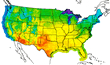
U.S. Day 1 Fire Weather Outlook
   ZCZC SPCFWDDY1 ALL
   FNUS21 KWNS 181652

   Day 1 Fire Weather Outlook
   NWS Storm Prediction Center Norman OK
   1152 AM CDT Mon May 18 2026

   Valid 181700Z - 191200Z

   ...EXTREMELY CRITICAL FIRE WEATHER AREA FOR PORTIONS OF EXTREME
   EASTERN NEW MEXICO...EXTREME SOUTHEASTERN COLORADO...SOUTHWESTERN
   KANSAS...PARTS OF THE TEXAS AND OKLAHOMA PANHANDLES...
   ...CRITICAL FIRE WEATHER AREA FOR PORTIONS OF THE SOUTHERN HIGH
   PLAINS...

   ...Morning Update...
   ***Dangerous fire weather conditions expected across parts of the
   southern High Plains this afternoon and evening***

   ...Southern High Plains...
   No changes were made to the fire weather risk areas. Despite good
   overnight humidity recoveries across much of the southern Plains, a
   volatile fire environment is expected to evolve this afternoon as a
   combination of very strong southwest winds of 25-35 mph (gusts
   exceeding 40 mph) and critically low RH overlap a region of
   profoundly dry fuels and active fires. Current surface observations
   depict a cold front draped across the northern TX Panhandle with
   weak northerly winds trailing behind, and a dryline slowly pushing
   east across the Caprock. The cold front is expected to gradually
   lift northward into southwest KS this afternoon as southerly winds
   increase and spread over the southern Plains. Uncertainty exists in
   how far north the front will lift, with some guidance portraying it
   lifting to the southwest KS/OK state line and stalling for a few
   hours. However, with numerous active fires and any new ignitions
   this afternoon, a drastic wind shift from southwesterly to northerly
   as the aforementioned front sweeps through the southern Plains this
   evening could further exacerbate the fire environment and any
   control efforts. The cold front is expected to progress southward
   after 00z, with strong northerly winds of 20-30 mph (gusts up to 40
   mph) immediately following the front, and breezy conditions
   persisting overnight. See the previous discussion for more
   information.

   ..Elizalde-Garcia.. 05/18/2026

   .PREV DISCUSSION... /ISSUED 0124 AM CDT Mon May 18 2026/

   ...Synopsis...
   ***Dangerous fire weather conditions expected across parts of the
   southern High Plains***

   ...Southwest into the southern High Plains...
   A pronounced mid-level trough will eject over the Plains, resulting
   in surface cyclone deepening over southwest Kansas, which will
   promote widespread, dangerously dry and windy conditions across
   parts of the Southwest into the southern High Plains today. A
   dryline will sharpen across southwestern Kansas into far western
   Oklahoma and northwest Texas by afternoon, with a very dry boundary
   layer mixing up to 500 mb in the post-dryline environment. Given
   strong downward mixing, as well as surface gradient flow with the
   deepening cyclone, widespread 20-30 mph sustained west-southwesterly
   surface winds overlapping with 5-15 percent RH is expected. These
   conditions are likely for several hours across much of New Mexico,
   to southwestern Kansas and points in between, necessitating the
   maintenance of Critical highlights.

   Extremely Critical highlights remain in place where confidence is
   highest in sustained surface winds exceeding 30 mph amid
   single-digit RH, and where the ERCs of fuel-loaded grasses exceed
   the 95th percentile. Guidance consensus suggests that this volatile
   overlap of favorable meteorological conditions and fuels will occur
   over extreme eastern New Mexico into the Oklahoma/Texas Panhandles
   and southwestern Kansas, immediately behind the dryline. The
   combination of the very strong surface winds/RH, critically dry
   fuels, and exacerbation of potential holdover fires will all support
   wildfire spread at a life-threateningly fast pace. The danger to the
   fire spread may be compounded later in the evening and early
   overnight hours, when the surface cold front sweeps into the region,
   resulting in a dramatic shift of the surface winds from westerly to
   northerly, pivoting any ongoing fire fronts accordingly.

   ...Sacramento Valley in California...
   A mid-level north-northwesterly wind maximum will overspread
   northern California during the afternoon hours, when a dry boundary
   layer is poised to mix up to the 700-500 mb layer. Such conditions
   will encourage enough downward mixing, in tandem with downslope
   flow, to support Elevated wildfire-spread conditions in the
   Sacramento Valley this afternoon. Sustained northerly surface winds
   in the 15-20 mph range coinciding with 15-20 percent RH will overlap
   with receptive fuels for at least a few hours, warranting fire
   weather highlights.
|
U.S. Day 2 Fire Weather Outlook
   ZCZC SPCFWDDY2 ALL
   FNUS22 KWNS 181927

   Day 2 Fire Weather Outlook
   NWS Storm Prediction Center Norman OK
   0227 PM CDT Mon May 18 2026

   Valid 191200Z - 201200Z

   ...Afternoon Update...
   Slight adjustments were made to the Elevated highlights across the
   Southwest based on recent guidance. Broad southwesterly winds of up
   to 15 mph will align with 15-20% RH atop dry fuels on Tuesday
   afternoon. Locally critical conditions may arise in terrain-favored
   areas where winds exceed 15 mph and RH decreases to near 10%,
   especially within the Middle Rio Grande Valley. Farther west,
   locally elevated fire weather conditions could emerge across the
   wind prone areas of Southern California where offshore winds are
   maximized (localized gusts exceeding 30 mph) alongside 10-15% RH
   atop dry grasses and shrubs.

   ..Elizalde-Garcia.. 05/18/2026

   .PREV DISCUSSION... /ISSUED 0150 AM CDT Mon May 18 2026/

   ...Synopsis...
   A broad mid-level trough will meander over the Intermountain West
   tomorrow (Tuesday), encouraging weak surface troughing over the
   Desert Southwest. Southerly flow will increase with daytime heating
   and boundary-layer mixing, with 15 mph sustained wind speeds likely
   amid 15-20 percent RH. Elevated highlights were introduced for
   central and southern New Mexico and immediate surrounding areas,
   where fuels are dry.
U.S. Day 3-8 Fire Weather Outlook
   ZCZC SPCFWDD38 ALL
   FNUS28 KWNS 182117

   Day 3-8 Fire Weather Outlook
   NWS Storm Prediction Center Norman OK
   0417 PM CDT Mon May 18 2026

   Valid 201200Z - 261200Z

   A progressive mid-level synoptic pattern will to transition to
   quasi-zonal flow on Day 3/Wednesday. Simultaneously, a weak
   shortwave trough will drift southward over the Intermountain West
   and across the northern U.S. through late this week. A combination
   of below normal temperatures and fairly widespread precipitation
   will overspread much of the central and eastern portions of the
   CONUS as synoptic flow stabilizes into the weekend. This could
   briefly dampen the fire weather threat across much of the country
   and support additional green up in some locations, particularly
   across the northern CONUS, that have thus far been struggling to
   grow fire-slowing vegetation. However, much longer duration
   precipitation and cool conditions would be needed to appreciably
   improve heavy dead fuel moisture and resultant ERCs.

   On Day 3/Wednesday, lingering moderate southwesterly flow aloft will
   encourage breezy conditions amid a dry airmass across
   central-western NM and eastern AZ. 40% Critical probabilities remain
   where southwest winds sustained at 10-20 mph will align with minimum
   RH of 10-20% atop dry fuels. On Day 4/Thursday, persisting low RH
   across the Southwest with much lighter winds will preclude the
   introduction of probabilities. Beyond Day 5/Friday, guidance begins
   to vary in the timing/extent of embedded shortwaves and associated
   chances of precipitation. Nonetheless, the overall upper pattern
   suggests dampened fire weather conditions on a broader scale through
   the forecast period, in the exception of localized terrain-driven
   breezy conditions across parts of the West.

   ..Elizalde-Garcia.. 05/18/2026
|
|